
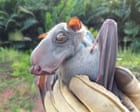
Biggest study of its kind provides insights into bats’ evolution – a potential gamechanger for research into treating viruses and cancer in humans In the northern forests of the Congo-Brazzaville, as the sun slips away, a distinctive honking fills the dusky sky. Every evening, thousands of hammer-headed fruit bats depart their daytime roosts in search of mates, calling out through large, box-shaped snouts that give the flying mammals the appearance of a winged moose. Here, along the Congo River, scientists have been collecting DNA swabs and tissue samples from the bats for years, working deep into the night in spacesuit-like protective gear. Those hard-won samples are now among the thousands of specimens gathered from bats across the world that have helped to reshape what we know about the bat family tree. Continue reading...
Back to Science
Science
September 23, 2026 at 3:00 PM
Bats originated in Europe, rewriting mammals’ family tree, study reveals
The Guardian Science