
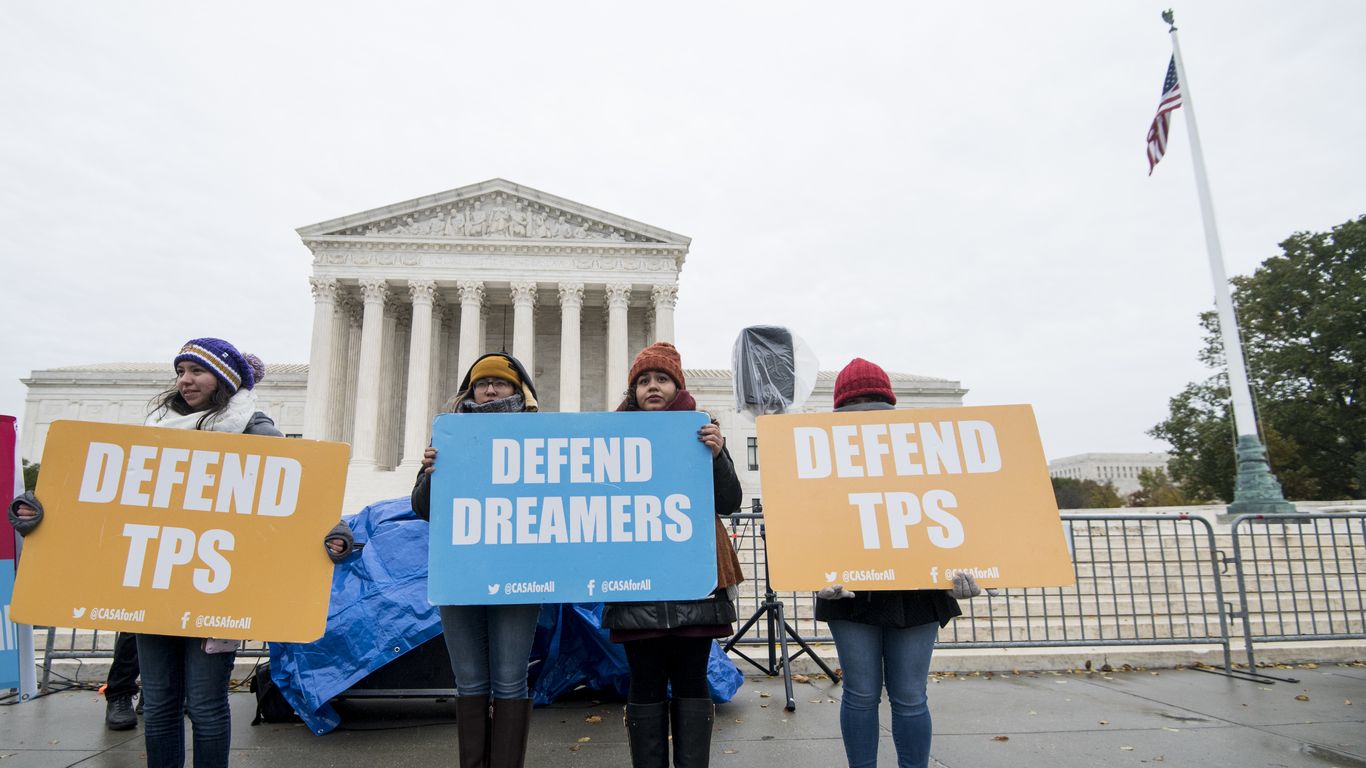
Hundreds of thousands of migrants are placing a last-ditch bet on Wednesday that the Supreme Court will side with them over former Homeland Security Secretary Kristi Noem. Why it matters: Noem terminated the temporary protective status (TPS) for asylum seekers from 11 countries last year. Now the Supreme Court has decided to hear challenges on two of those terminations at the same time. Zoom in: The law that established TPS protections from deportation says the decisions can't be challenged in court. But the TPS holders are making their argument on process. TPS is given by nationality based on the safety conditions in that country after a natural disaster or dangerous conflict. A review is done periodically on whether it should be extended or terminated. The government is arguing that "the courts aren't allowed to look at any of this and that any decision they make, any rule that they set for TPS, is immune from review entirely," Ahilan Arulanantham, an attorney arguing on behalf of Syrians in the case, said on a recent press call. "A huge amount is at stake in that dispute because if the government is correct, then they can terminate TPS without conducting any country conditions review at all," he added. What we're reading: Court documents showed limited review from Noem when she terminated TPS status for several countries last year. "The sole correspondence from the State Department to DHS in the record is a two-sentence email concerning the TPS designations of four countries. The email never references country conditions," a court filing from the TPS holders said. An anonymous former immigration official told the New York Times magazine that to end TPS: "Countries I'd written up as unsafe a few months earlier were supposed to be safe now. It was a complete farce." The other side: Noem's agency stressed in numerous press releases that she was restoring integrity to TPS by keeping it temporary as she announced the termination each country's designation. "Congress forbade federal courts to second-guess TPS determinations, no matter whether courts would cavil with the final outcome, the Secretary's decisional process, the substantive reasoning, or something else," the government argues in its court filing. Zoom out: There are about 1.3 million people in the U.S. living with TPS. The Trump administration terminated the designations for 11 of the 15 nationalities. The others will come up for consideration later in Trump's term (in addition to a second designation for Venezuela). The intrigue: The Haitian TPS holders are also allowed to make another argument that their termination of status was racially motivated and pre-determined by the Trump administration, going back to when he still on the campaign trail. A bipartisan bill passed the U.S. House to reinstate deportation protections for Haitians. It has not been taken up in the Senate. The bottom line: Even if the TPS holders get the court to rule that the terminations for Haiti and Syria are illegal, new DHS Secretary Markwayne Mullin could arrive at the same conclusion after a more thorough review.
Back to Top News
Top
April 29, 2026 at 8:40 AM
Migrants blame Kristi Noem in appeal to Supreme Court
Axios


